
WASHINGTON ― A provision in the GOP’s tax-and-spending bill that would make it nearly impossible for anyone to sue the Trump administration for breaking laws is on track to be stripped from the bill after the Senate parliamentarian said it violates the chamber’s rules.
HuffPost is dedicated to holding lawmakers accountable and covering how their actions impact you, your community, and the country. Support journalism that demands transparency — join our membership program today.
This provision, which is in Senate Republicans’ version of the One Big Beautiful Act, would require anyone seeking an emergency court order ― that is, a temporary restraining order or a preliminary injunction ― against the federal government to first post a bond that covers all the costs and damages that would be sustained to the federal government.
Judges grant emergency orders to temporarily halt actions like deportations, bans or drilling, while a case is being decided. They typically waive bonds in public interest cases, but under the Senate GOP’s bill, public interest groups, or even individual plaintiffs, would have to cough up millions if not billions of dollars in order to seek an emergency court order against the Trump administration ― money they definitely don’t have.
In short, this provision would allow Trump to serve as a king, free to ignore the courts amid his lawlessness.
Advertisement
The Senate parliamentarian, the chamber’s nonpartisan adviser on Senate rules, determined Saturday that this provision is not related to budget matters. Republicans are using a process called budget reconciliation to expedite passage of their tax bill, which allows them to advance it with 51 votes instead of 60. But this process is only for budget-related bills, so any language in the bill that the parliamentarian flags as unrelated to budgets is subject to 60 votes.
With Democrats united against this provision and Republicans only holding 53 votes, it’s almost certainly coming out of the bill. Democrats are already signaling their plans to invoke the so-called Byrd Rule to strip this and other language out when the Senate begins debate on this bill in the coming days. The Byrd Rule is the Senate rule that requires that any bill being advanced through the budget reconciliation process be only related to budget matters.
“We continue to see Republicans’ blatant disregard for the rules of reconciliation when drafting this bill,” Sen. Jeff Merkley (D-Ore.) said in a Saturday statement. “Today, we were advised by the Senate Parliamentarian that several more provisions in this Big Beautiful Betrayal of a bill will be subject to the Byrd Rule – and Democrats plan to challenge every part of this bill that hurts working families and violates this process.”
Advertisement

Kevin Dietsch via Getty Images
It’s possible that Senate Majority Leader John Thune (R-S.D.) could choose to ignore the parliamentarian’s ruling and not allow Democrats the 51-vote threshold to take this language out of the bill. But that would be a major departure from the Senate’s long history of abiding by the chamber’s rule-enforcer. It won’t be clear what Thune’s next step is until the bill hits the Senate floor.
On Sunday, Senate Minority Leader Chuck Schumer (D-N.Y.) was already celebrating that Democrats forced the GOP to take the provision out.
Advertisement
“Senate Republicans tried to write Donald Trump’s contempt for the courts into law ― gutting judicial enforcement, defying the Constitution, and bulldozing the very rule of law that forms our democracy,” Schumer said in a statement.
“But Senate Democrats stopped them cold,” he said. “We successfully fought for rule of law and struck out this reckless and downright un-American provision.”
Here’s the provision currently in Senate Republicans’ bill:

U.S. Senate
Advertisement
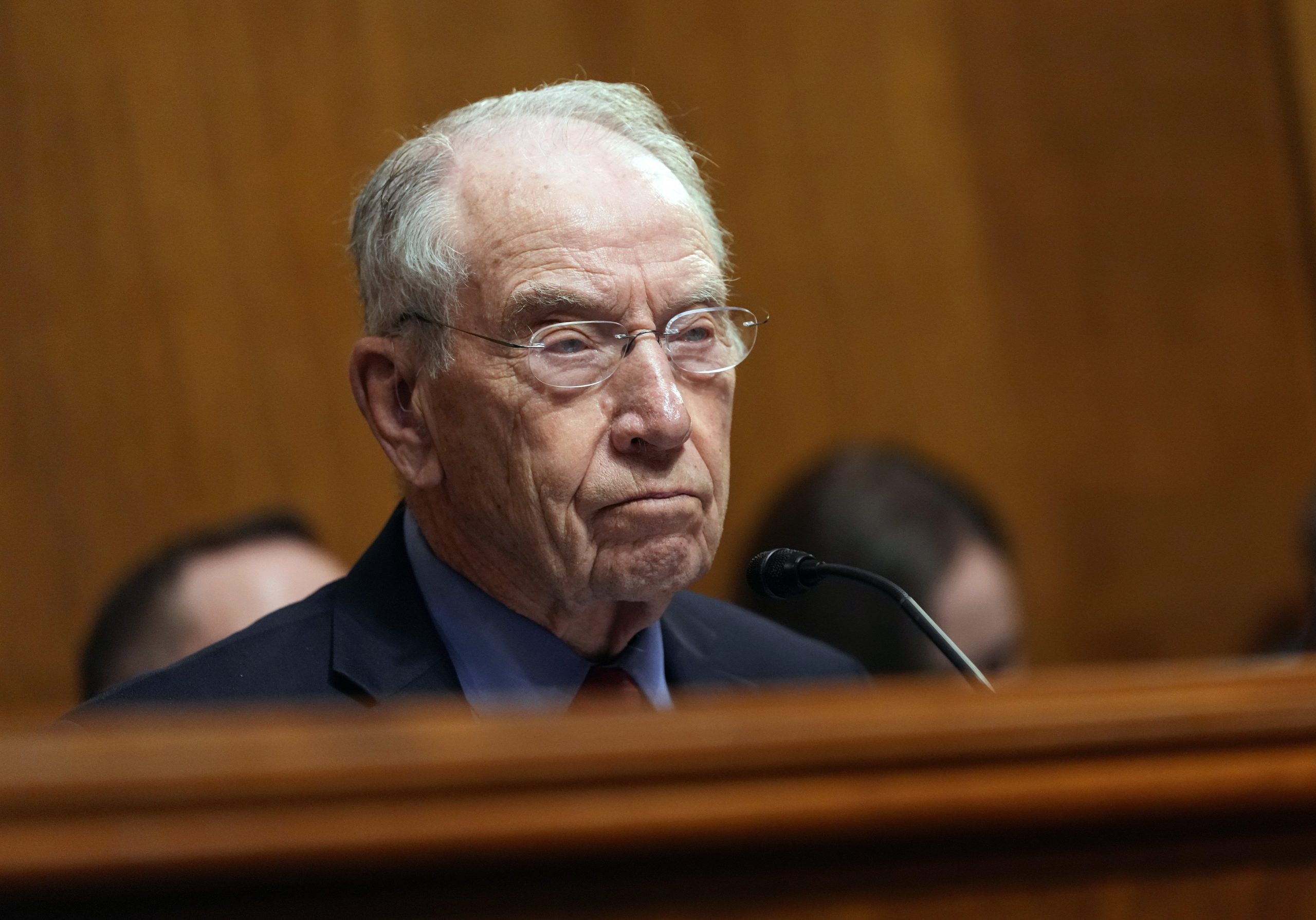
On Tuesday, HuffPost asked Senate Judiciary Committee chairman Chuck Grassley (R-Iowa) why he and other Republicans on the panel put this provision into the bill at all.
“Yeah, it’s pretty simple,” Grassley said. “There’s no constitutional authority. There’s no statutory authority for national [injunctions].”
HuffPost reiterated that the effect of this language is that it prices out public interest groups from being able to sue the Trump administration, something they’ve been very, very successfully doing for months. Grassley, visibly irritated, offered a confusing defense of this provision. He insisted judges don’t have the authority to issue injunctions, which they do.
Advertisement
“You’re talking about the authority of judges to put national emergency,” he said, his voice rising. “Forget about who can enter the courtroom for anything, because judges can only see cases and controversy. They don’t have any authority to issue a national injunction, but if you do do an injunction, you’re supposed to put a bond up, and they haven’t put bonds up.”
Asked again about this provision making it too expensive for public interest groups to be able to sue the Trump administration at all, Grassley said, “Well, it seems to me, if you don’t even have authority in the Constitution or in the laws, to have national injunctions, you shouldn’t even be asking that question!”
He walked off in a huff.
