

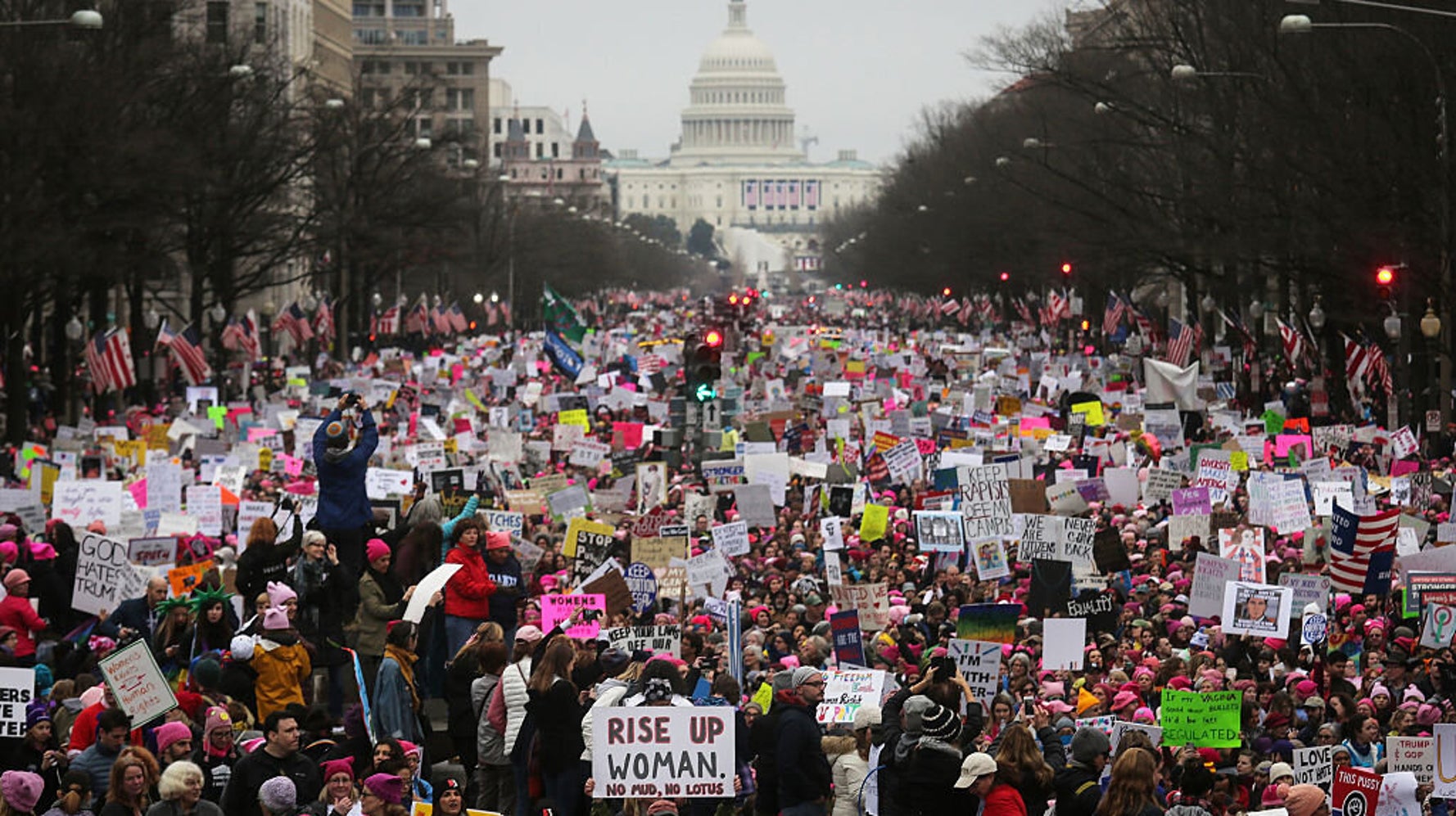
In a stunning revelation, officials of the National Archives have admitted that a photo of the 2017 Women’s March was altered to blur-out signs with messages critical of Donald Trump — and words referring to the female anatomy, The Washington Post reported.
Changes included blocking out the name “Trump” in a sign that read “God Hates Trump.” The resulting sign then said simply: “God Hates.” The name was also deliberately blurred in a sign reading “Trump & GOP — Hands Off Women.”
Words on other signs referring to women’s genitals were also altered, according to the Post. The word “vagina” was obliterated in a sign reading: “If my vagina could shoot bullets, it’d be less REGULATED.” The word “pussy” was removed from another message reading: “This Pussy Grabs Back.” The sign was a reference to Trump’s recorded boast about getting away with grabbing women “by the pussy.”
At least four signs were altered by the organization that touts itself as “the nation’s record keeper,” according to the Post.
“As a non-partisan, non-political federal agency, we blurred references to the President’s name on some posters, so as not to engage in current political controversy,” Archives spokeswoman Miriam Kleiman said in a statement to the newspaper.
As for eliminating references to women’s genitals, the words could be perceived as inappropriate, according to Kleiman.
The 49-by-69-inch photo of the Women’s March by Mario Tama for Getty Images was altered before it was displayed in an exhibit at the National Archives marking the 100th anniversary of women’s suffrage. The Women’s March was held the day after Trump’s inauguration.
David Ferriero, the archivist of the United States appointed in 2009 by then President Barack Obama, reportedly participated in talks about the display, and supported the decision to change the photo.
Furious critics complained that the institution is supposed to be a reliable record of reality.
Doctoring an image honoring women’s rights is particularly disturbing, Purdue History Professor Wendy Kline said in an email to the Post. It “buys right into the notion that it’s okay to silence women’s voice and actions,” she wrote. “It is literally erasing something that was accurately captured on camera. That’s an attempt to erase a powerful message.”
Rice University historian Douglas Brinkley told the Post that “there’s no reason for the National Archives to ever digitally alter a historic photograph. If they don’t want to use a specific image, then don’t use it. But to confuse the public is reprehensible.”
Kleiman said the “mission” of the Archives’ is to “safeguard and provide access to the nation’s most important federal records,′ even, apparently, when those records are modified to no longer be accurate.
Officials refused to reveal any other records that had been changed, the Post reported.
Critics of the move erupted on Twitter.
Calling all HuffPost superfans!
Sign up for membership to become a founding member and help shape HuffPost’s next chapter
