

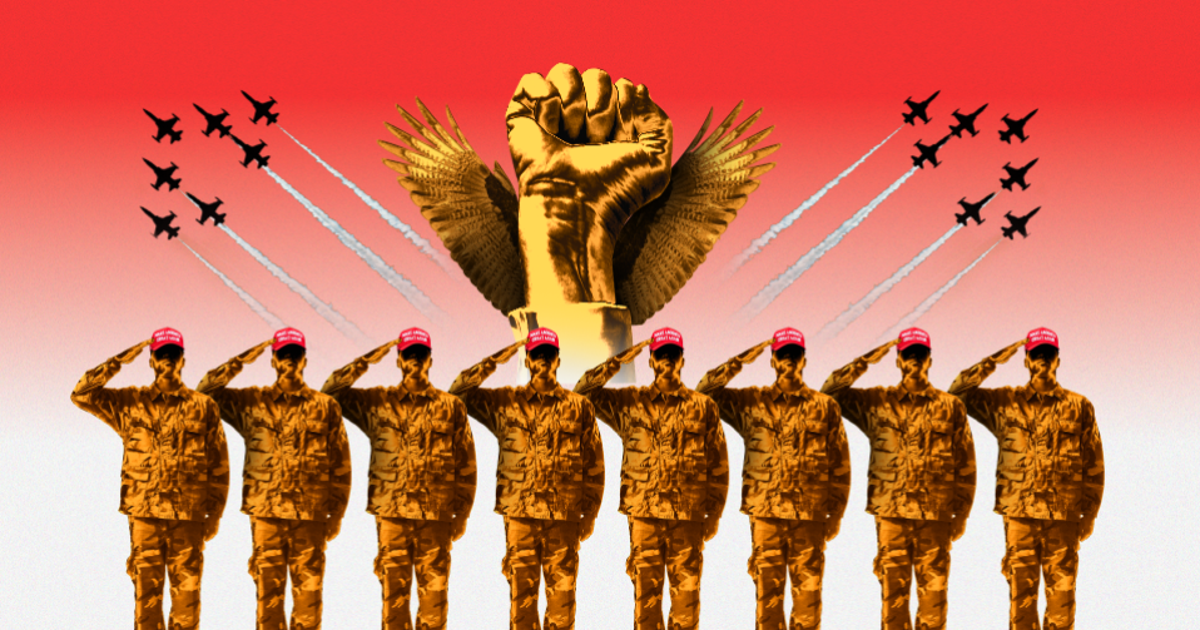
President Donald Trump is about to get the made-for-TV image that he has always wanted.
On June 14 — also his birthday and Flag Day — Trump is set to oversee a military parade featuring tanks, military flyovers, and 6,000 troops in modern and historical uniforms marching down Constitution Avenue. Estimated to cost upward of $45 million to taxpayers, the parade, which was a late addition to celebrations planned for the 250th anniversary of the Army, should give Trump the flashy militaristic display he has wanted since his first term. At the time, Pentagon officials shut down the idea because they thought tanks rolling down Pennsylvania Avenue would make the United States look “very Red Square.”
But this weekend’s scheduled festivities provide Trump with the perfect opportunity to project the image of dominance and triumph his administration has worked to cultivate, echoing the styles and visuals of authoritarian nations past and present — even as the country has been engulfed in chaos, including over the last week as Trump deployed the National Guard and Marines to quell protests to immigration raids in Los Angeles.
Advertisement
There is a term for what Trump is doing: the “aestheticization of politics.”
The parade is a culmination of an ongoing attempt to build a Trumpian aesthetic, one that not only props up Trump as a source of strength but offers the sense of an unfettered expression of power to his supporters, while simultaneously stripping the rights of those — immigrants, trans people, and others — who exist outside the administration’s imagination of who belongs in America.
“These aesthetics really are why people are attracted to these leaders,” said Jessica Winegar, professor of anthropology at Northwestern University. “It’s not necessarily about the substance. It’s about the expression, it’s about the visuals, it’s about the sense of power that attracts people who don’t have power.”
This story is part of HuffPost’s commitment to fearlessly covering the Trump administration. You can support our work and protect the free press by contributing to our newsroom.
By leaning into the visuals and the aesthetics of strength, Trump does not have to contend with the reality that his administration, and its individual actions, are largely unpopular.
The administration wants people to forget, or at least ignore, that it flouts court orders or deports U.S. citizens erroneously, Winegar explained. It wants to hide how it violates bedrock American legal principles like due process, that it cracks down on free speech, and that it targets LGBTQ+ people across the nation. (In a cruel irony, while the administration will celebrate the achievements of the U.S. Army service members’ valor and integrity, the administration continues to defend its ban of trans people from serving or enlisting — despite being perfectly qualified — and helped strip them of their benefits while telling them they are untrustworthy and undisciplined.)
The White House did not directly answer HuffPost’s questions on the parade, including about how, or whether, it intended to draw a line between a celebration of Trump’s birthday and a celebration of the Army.
Advertisement
“Only the TDS-ridden ‘reporters’ at Huffington Post could take issue with President Trump’s efforts to honor our military men and women with a grand parade on the U.S. Army’s 250th Anniversary. The President looks forward to giving our nation’s heroes, including those who died in the line of duty, the respect they deserve with this historic, patriotic event,” said spokesperson Anna Kelly, using an abbreviation for “Trump Derangement Syndrome.”
But Winegar said Trump can take an event like the Army parade and use it as proof that everything is going swimmingly in the United States.
“But all of the effort is put into these events and then the actual change that would make people’s lives better is not happening,” she said.
Advertisement
The Aesthetics Of Politics
The concept of the “aestheticization of politics” was coined by the German Jewish philosopher Walter Benjamin. In a 1935 essay of cultural criticism, Benjamin wrote that fascist regimes require a kind of aestheticization of politics that allows the masses to see and express themselves through a big spectacle without the regime actually materially changing the lives and rights of the people.
In “earlier moments of fascism,” Winegar said, the aestheticization of politics was done through parades, speeches, film and photography, even architecture.
Adolf Hitler’s 50th birthday in 1939 was ushered in with a massive parade in Berlin, along with youth marches and an array of festivities and ceremonies including goose-stepping Nazi troops who marched while playing drums and trumpets as they passed beneath the gaze of the dictator from his viewing stand. That same year, 20,000 people gathered for another meticulously planned Nazi rally in New York City’s Madison Square Garden. Decades later on the campaign trail, Trump held a rally at the same arena where thousands of his red-hatted supporters cheered at his promise to “rescue” America from the “migrant invasion” of the country.
Advertisement
Michael Tymkiw, an art history professor at University of Essex in England who has studied visual culture and spectatorship under authoritarian regimes, said that social media platforms like Elon Musk’s X and Trump’s Truth Social, alongside the 24-hour newsroom, have let people engage with and observe politics more than they have been able to in previous eras.
Trump, a former reality-TV star who spent decades crafting his public image, is able to take full advantage of the spectacle.
“We see a lot of impromptu stuff and I think it’s all part of this projection of power to encourage these forms of anticipatory obedience,” Tymkiw said, referring to the ways in which universities, law firms, corporations and media companies have bent to Trump’s force.
Advertisement
Tymkiw thinks back to the moment that Trump berated Ukrainian President Volodymyr Zelenksyy during their live televised meeting in February. It was “exemplar of reality TV-ness, it was loosely scripted and seemed off the cuff,” he said. “Just like you would be thinking about the ‘Real Housewives of Beverly Hills’ being like, ‘I cannot believe she just said that’ and although we can think of it as lighthearted, the consequences are anything but.”
In the aftermath, Trump paused U.S. support for Ukraine’s war with Russia, upending the status quo, imperiling peace negotiations, and drawing condemnation from international allies.
As the cameras were still rolling in the Oval Office, though, Trump said, “This is going to be great television.”
Advertisement
Trump’s ability to aestheticize his politics through “social media and celebrity culture” is a uniquely American and 21st-century manifestation of authoritarianism, Winegar said.
“Other authoritarian leaders in other eras did not [have continuous celebrity power] because while it was produced in [typical] media, the flow wasn’t constant, every day,” she said.
Trump trades substantive politicking or meaningful oratory for a constant barrage of social media posts or rallies, and he has not hesitated to take advantage of opportunities to flood the zone with images of him appearing powerful. Even when Trump was being hauled off stage in Butler, Pennsylvania, following an assassination attempt, the image he conveyed was immediate and cinematic: a raised fist as he cried out “fight, fight, fight!”
Advertisement
A portrait of that moment now hangs in the White House.
And then there is the meme-ified propaganda, often created by others and re-promoted by Trump. From the golden gilding of the Oval Office to the projection of his Mar-a-Lago estate as the “center of the universe” to his amplification of AI-generated images portraying him as the pope or a muscle-bound NFL footballer or a Star Wars Jedi all go toward building an image of Trump as a supposed icon of power.
The Art Of Distraction
And then there’s the veneer of success, or at least what the administration wants to frame as success.
“We see that the primary economic concerns that your average American has — related to living wages, rising health care costs, relating to inflation — there’s not a significant attempt to change the structural system that is produced this situation that these individuals find themselves under and instead there is a lot of effort put into the ‘aesthetics of success,’” Winegar said.
Advertisement
To wit, Trump’s game of chicken over tariffs has not only upset longtime international allies and sparked global trade wars, but roiled the stock markets — causing retirement accounts for many Americans to shrink, and risking lowering the standard of living for everyday Americans. And despite Trump’s promise to promote business on American soil, his administration’s large-scale deportations have actually done the very opposite for the domestic economy — even beyond the callous nature of Immigration and Customs Enforcement raids. A June 2 study released by Clarify Capitol found that ICE raids, deportations and visa denials have caused 1 in 5 business owners to lose employees and at least 69% of business owners surveyed saying they would consider relocating to states with more flexible immigration policies.
And then there is the social upheaval. The administration’s agenda of mass deportations is rupturing communities, throwing cultural institutions like schools into chaos, and creating a culture of fear where even those in the country legally, including U.S. citizens, cannot be certain of their own safety or stability.
Advertisement
The messaging is simple: Disregard the substance, focus on the style.
“What happens often in these authoritarian aesthetics is that people come to identify themselves with the ruler in the sense that if they celebrate him — and it’s always a him — if they celebrate him and they’re putting trust in him, they will eventually become like him, so they will be themselves successful, they will be able to have the kind of success, for example, that Donald Trump has had,” Winegar said.
And once people put trust in the authoritarian, they come to believe the reality that he shapes even if there’s a blatant, and gleeful, disregard for what is true. Trump’s embrace of the racist “birther” movement’s lies about former President Barack Obama’s citizenship, his false claims that the 2020 election was “stolen,” and his ongoing rhetoric about the threat of immigrants “invading” American cities have created a shared reality built on falsehoods, which has given him cover and credence for his overreach of executive authority.
In April 2024, a poll by the Washington Post-Schar School found that 28% of all Americans believe Trump when he lies and regardless of the subject he is speaking on.
Advertisement
“The question that then emerges is, how does post truth shape aesthetics?” Tymkiw, the art historian, said.
By piggybacking on the Army’s image of ultra-American brawn and cohesion, Winegar said, the Trump administration gives a facade of legitimacy to its proclaimed devotion to the ideals of liberty, democracy and freedom, even as it actively works to tear down those ideals.
On Tuesday, Trump’s spectacle met his crackdown on those ideals, when he warned that anyone protesting his parade “will be met with big force.”
Advertisement
“But this is people that hate our country. They will be met with heavy force,” he said.
That is not stopping dissenters.
The 50501 movement, a grassroots coalition of state and local activists, have dubbed June 14 “No Kings National Day of Defiance.” Organizers are encouraging people around the nation, including children and families, to peacefully protest “authoritarianism, billionaire-first politics, and the militarization of our democracy.”
“It’s a pointless show of strength and self-aggrandizement, considering that the Trump regime has little to celebrate — besides the on-again-off-again tariffs and his Gestapo (ICE) arresting hard-working Americans without due process,” a spokesperson for the group told HuffPost of the parade. “Our issue is with the celebration of authoritarianism at the expense of taxpayer dollars and our fundamental freedoms.”
The group has gatherings scheduled for cities in every state. In Los Angeles alone, organizers of 50501 say they expect up to 250,000 people to peacefully protest.
Advertisement
That participation is essential, Winegar said. And it’s equally important to take what the president is doing — or attempting to project — seriously.
“Don’t stop at making fun of it. Take it seriously because this is why he won,” she said.
